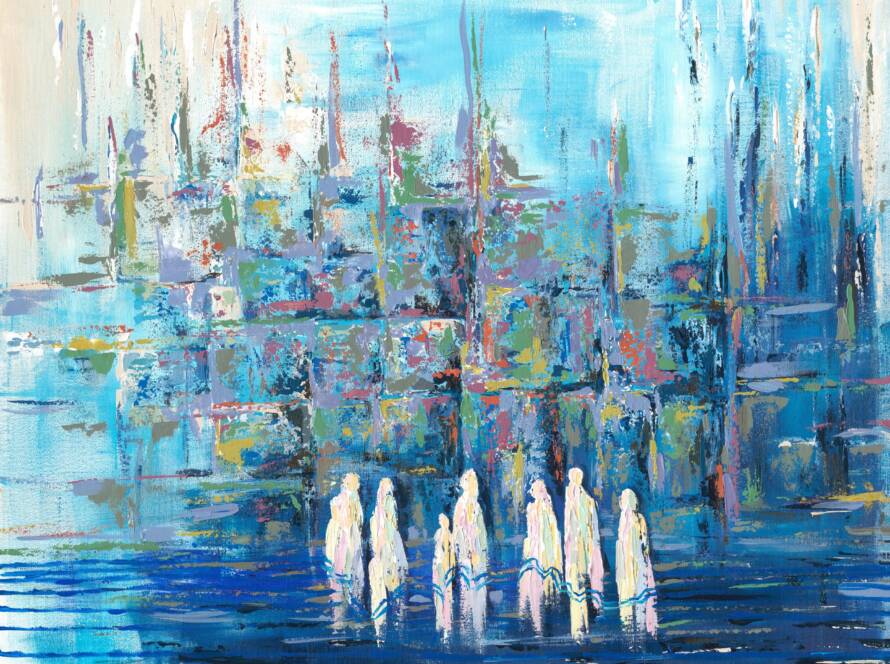
There is a moment in Hasidic dance when the feet leave the ground — just barely — and for that breath of time, the soul is entirely free. I have watched this happen countless times here in Jerusalem, at weddings and celebrations, at Simchat Torah gatherings and Shabbat tisches, and each time it moves me in the same way. The circle forms, the melody rises, and something beyond words takes hold. As a painter, my deepest wish is to hold that moment still — not to freeze it, but to let it live on canvas so others can feel what I have felt.
When the Body Becomes Prayer
In Jewish tradition, dance is not performance. It is prayer made visible. The Baal Shem Tov taught that the body itself can serve Hashem, that every movement — a turn of the wrist, a stamp of the foot — can become an act of devotion. When Hasidic men join hands and move in a circle, they are not simply celebrating. They are creating a vessel for holiness, a space where individual egos dissolve into something greater. The circle has no beginning and no end, just as the connection between a Jew and the Creator has no beginning and no end.
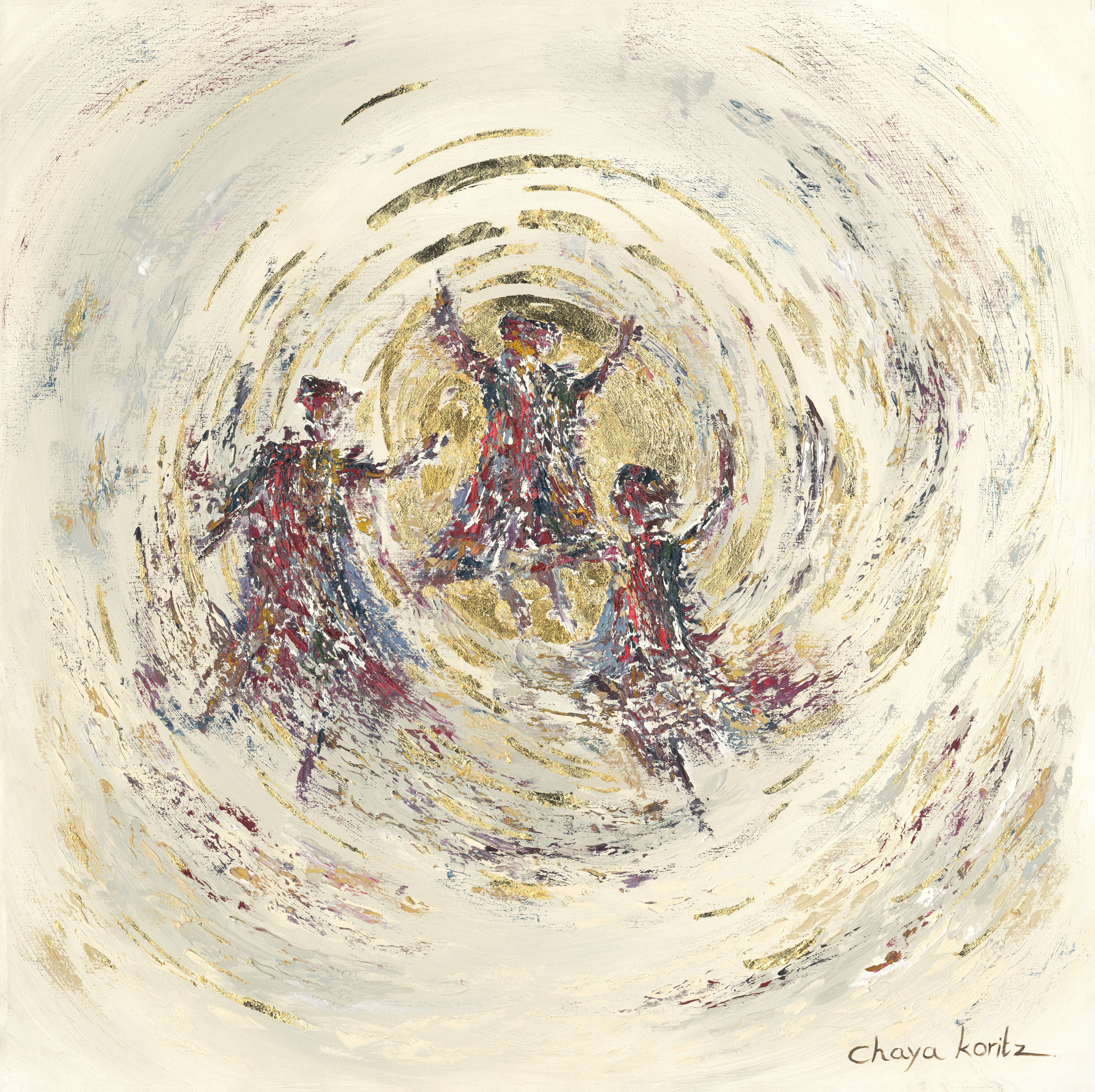
This is what I tried to capture in my painting Circle of Faith. Three Hasidic men move together inside a luminous golden ring. Their forms are suggested rather than detailed — I wanted you to feel the energy of the dance rather than study the dancers. The gold leaf surrounding them is not merely decorative; it represents the divine light that fills the space when Jews come together in genuine joy. The muted earth tones of their garments ground the figures in this world, while the gold lifts them toward the next.
Stillness and Movement: Two Sides of Devotion
Dance and prayer may seem like opposites — one is outward and physical, the other inward and still — but in Hasidic thought, they flow from the same source. The same fire that makes a man sway during the Amidah is the fire that sends him spinning across the floor at a simcha. I see this duality every time I visit the Kotel. Some worshippers stand perfectly still, wrapped in their tallitot, while others rock and sway with an intensity that is almost like dance. Both are reaching for the same thing.
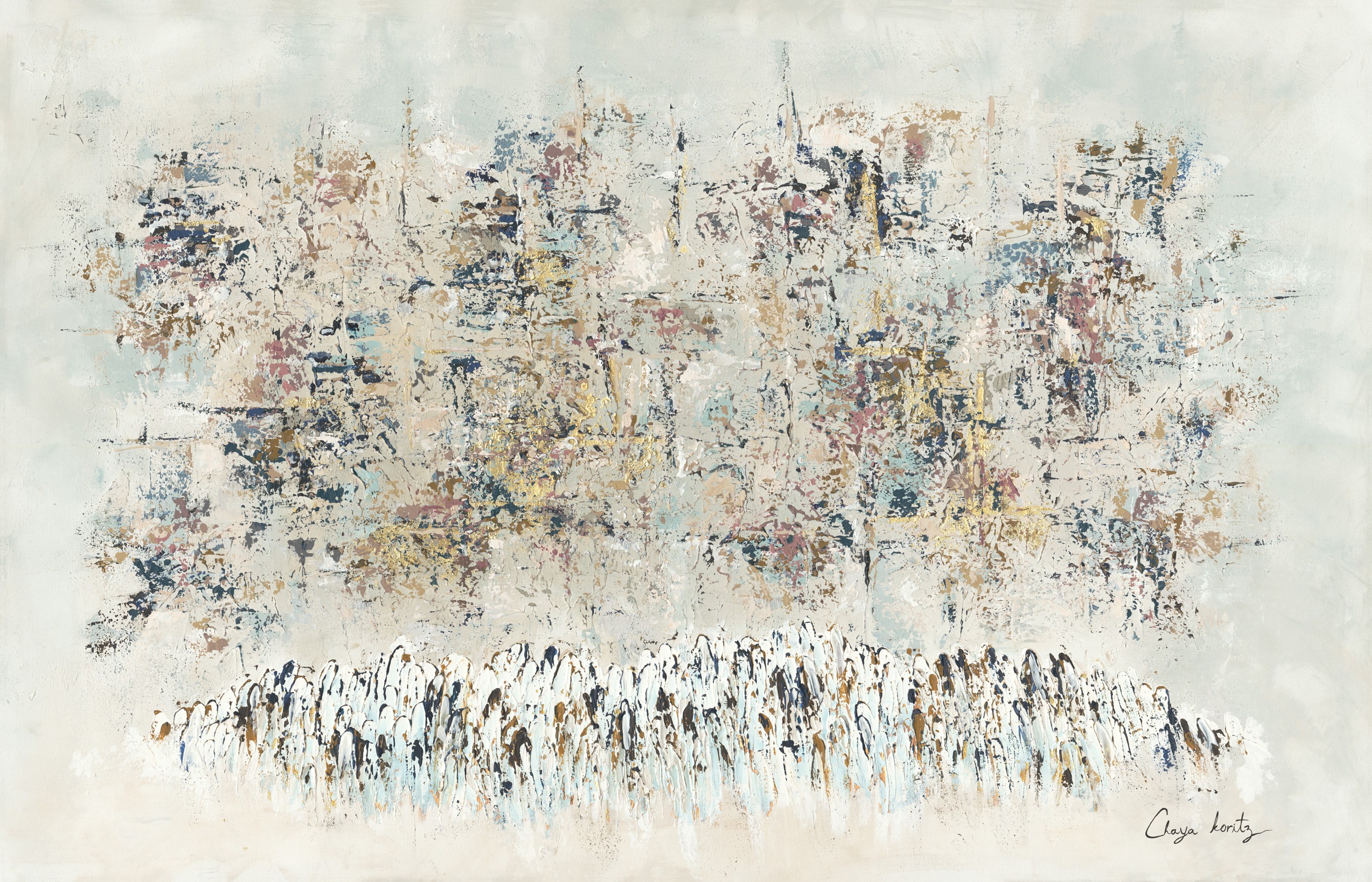
My painting Past and Present in Perfect Harmony explores this idea. A group of Chassidim are gathered at the Western Wall, and there is a quiet rhythm to the scene — the way the figures lean together, the gentle repetition of dark coats against ancient stone. The composition has a musical quality, as though the figures themselves are notes in a niggun. Soft tones of grey, blue, and warm gold create a sense of timelessness, connecting the prayers of today to those of centuries past.

Where Joy Gathers
One of the things I love most about painting communal scenes is the challenge of showing individual souls within a group. Every person in a circle of dancers carries their own story, their own pain and gratitude, yet for those few minutes of dance, all of it merges into collective joy. The Talmud teaches that when Jews rejoice together, the Shechinah dwells among them. I believe this with my whole heart, and I try to make that invisible presence visible through light and texture.
In Where Souls Meet, I painted a gathering at the Kotel bathed in soft, pale light — almost as if the stones themselves are glowing from within. The figures blend gently into one another, suggesting that in moments of deep spiritual connection, the boundaries between people grow thin. Warm filtered tones wash over the entire canvas, creating an atmosphere of quiet reverence that is, in its own way, a kind of dance — a dance of souls rather than of bodies.
“Every step in a Hasidic dance is a prayer, and every prayer is a step closer to the divine. My brush tries to walk that same path.”
Bring the Spirit of Dance Into Your Home
When you hang a painting of Hasidic dance in your home, you are not simply decorating a wall. You are inviting that spirit of communal joy, of faith expressed through movement, into your daily life. Whether it greets you in the morning or catches your eye as Shabbat candles flicker on Friday night, it becomes a quiet reminder that celebration and holiness are never far apart.
If you would like to learn more about these paintings or explore bringing one into your own space, I would love to hear from you. Please visit my contact page and let us start the conversation.