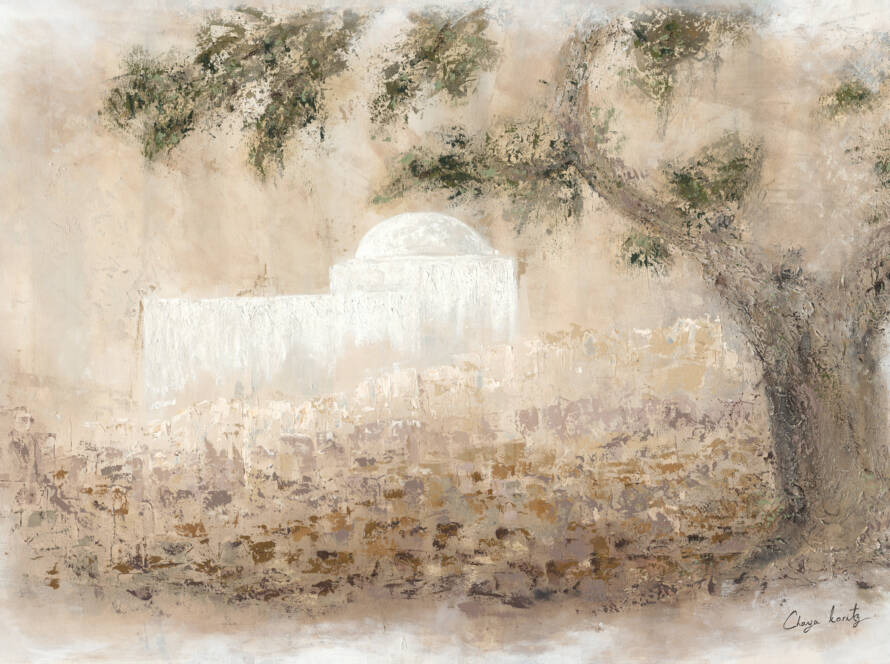
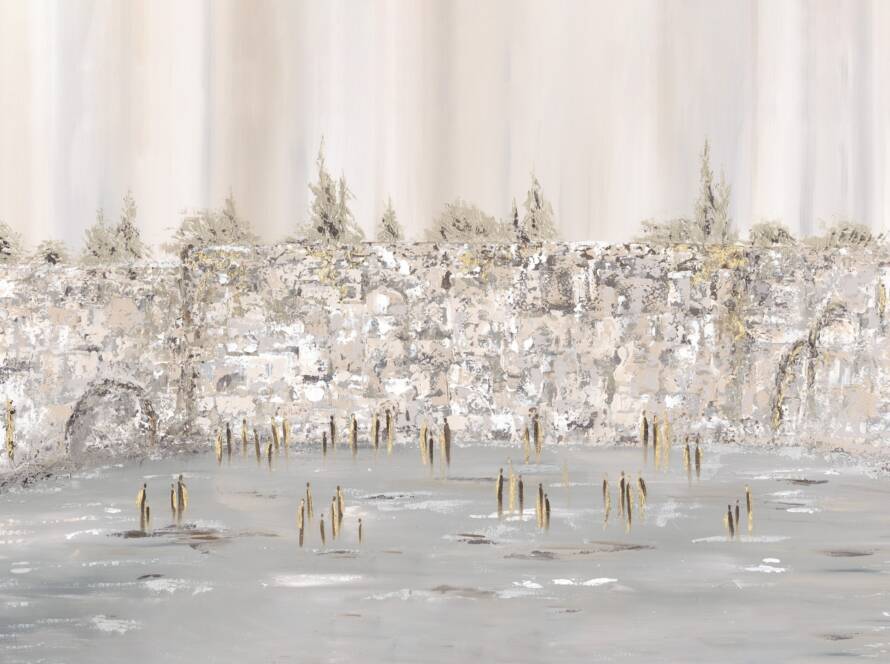
There are places that live beyond geography. Places that exist not only in stone and mortar but in the collective heartbeat of a people. For me, the Beit HaMikdash — the Holy Temple — is exactly that kind of place. It is a place I have never physically stood inside, yet one I have carried with me my entire life. When I set out to paint Where Time Stands Still: A Vision of the Beit HaMikdash, I wanted to capture that paradox — a structure destroyed thousands of years ago that somehow remains more present than ever.
Why the Holy Temple Still Matters
Living in Jerusalem, I am surrounded by layers of history every single day. The stones beneath my feet, the light that falls across the Old City walls at dusk — all of it whispers of what once was and what we still hope for. The Beit HaMikdash was the spiritual center of the Jewish people, the place where heaven and earth were said to meet. Its destruction was not merely a loss of a building; it was a rupture in the relationship between the divine and the everyday.
And yet, Jewish memory refuses to let it disappear. Every prayer turns toward it. Every Tisha B’Av mourns it. Every wedding glass shattered underfoot remembers it. This is the tension I wanted to hold in my painting — the space between absence and presence, between mourning and hope.
The Painting Process: Building with Light and Memory
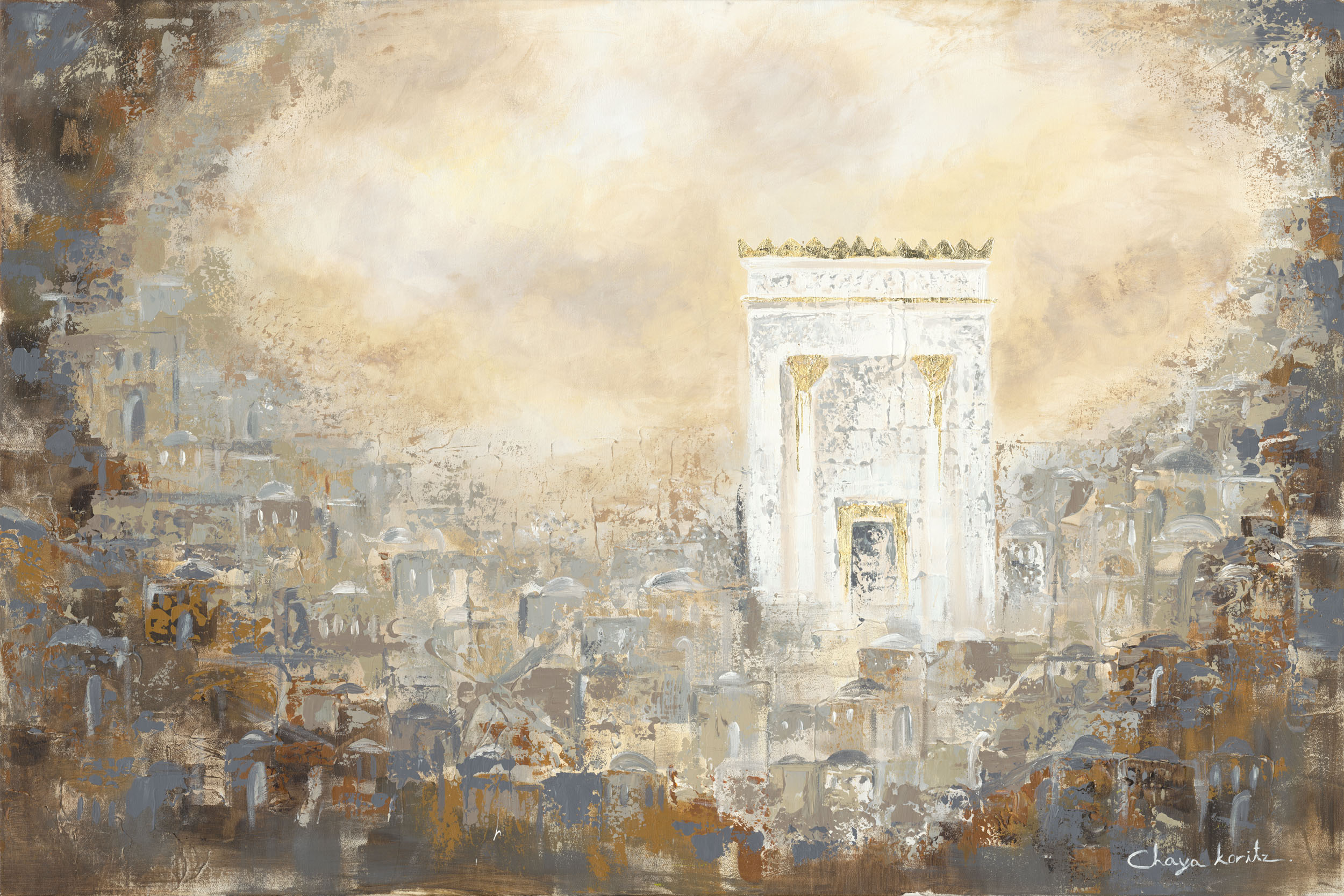
When I began working on this piece, I knew I did not want to create a historical illustration. I was not interested in architectural accuracy. Instead, I wanted to paint the feeling of the Beit HaMikdash — the way it lives in our collective imagination. I worked with muted earth tones and soft golds, allowing the Temple to emerge from the canvas almost like a vision rising through mist. The gold accents are not decorative; they represent the divine light that tradition tells us filled the Temple’s inner chambers.
“The Beit HaMikdash is not something I paint from a reference photo. It is something I paint from the inside — from prayer, from longing, from the Jerusalem light that still carries its memory.”
There is a deliberate softness in this work. The edges blur, the forms overlap. This is intentional — the Holy Temple exists for us in a liminal space, somewhere between history and prophecy, between what was and what will be. I wanted viewers to feel as though they were glimpsing it through time itself.
Jerusalem as Living Canvas
The Beit HaMikdash does not exist in isolation. It is woven into the fabric of Jerusalem, a city that itself layers past upon present with every stone. This is something I explore across several of my paintings. In Jerusalem Unveiled: Layers of Time and Light, I work with that same principle of layering — building the city’s architecture in overlapping planes of soft color, suggesting how Jerusalem holds centuries within a single glance.
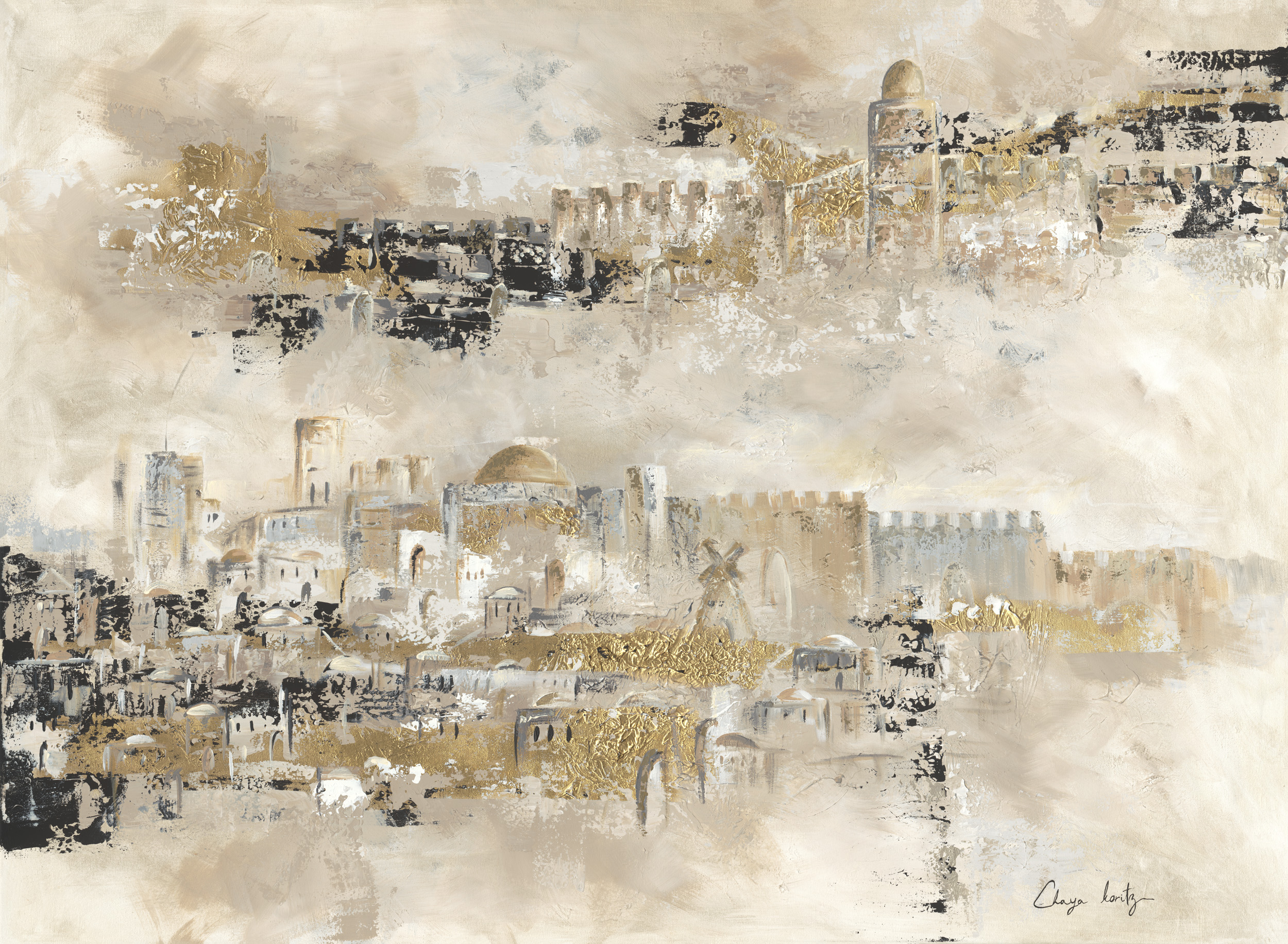
And in Golden Jerusalem: Strength, Spirit, and Sacred Beauty, the gold leaf becomes a language of its own — not just ornamentation, but a way of expressing the sacred light that tradition ascribes to this city. Gold, in my work, always carries spiritual weight. It is the material echo of something invisible and eternal.
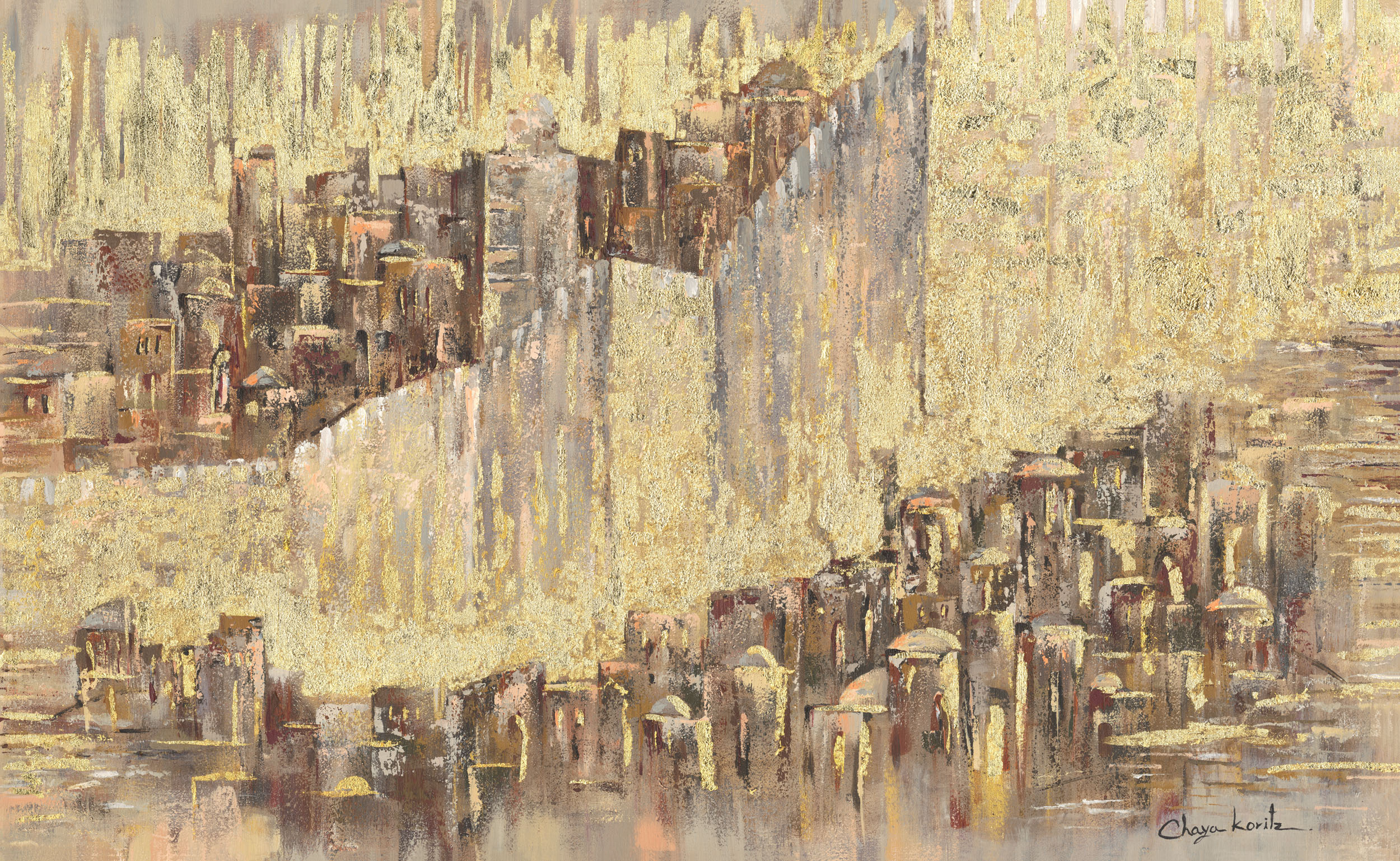
Together, these three paintings form a kind of trilogy — each approaching Jerusalem and its holiest site from a different angle, yet all sharing the same quiet reverence, the same palette of earth and gold, the same belief that art can hold what history alone cannot.
All three are originals on canvas. Where Time Stands Still: A Vision of the Beit HaMikdash is acrylic on canvas at 80 × 120 cm (32 × 47 in); Jerusalem Unveiled: Layers of Time and Light is acrylic and gold leaf on canvas at 80 × 130 cm (32 × 51 in); and Golden Jerusalem: Strength, Spirit, and Sacred Beauty is acrylic and gold leaf on canvas at 80 × 140 cm (32 × 55 in).
Carrying the Temple Forward
There is a teaching that says every Jewish home is a mikdash me’at — a small sanctuary. I think about this often when I paint. If the Holy Temple was the place where the divine presence dwelled, then perhaps art can serve as a window back to that presence. When someone hangs one of these paintings in their home, they are not just decorating a wall. They are making a quiet declaration: this matters to me, this memory lives here.
The Beit HaMikdash may belong to the past, but its meaning belongs to every generation. Painting it is my way of keeping that conversation alive — between what was sacred then and what remains sacred now.
If this vision of the Holy Temple speaks to you, or if you would like to learn more about bringing one of these paintings into your home, I would love to hear from you. Please visit my contact page to start a conversation.