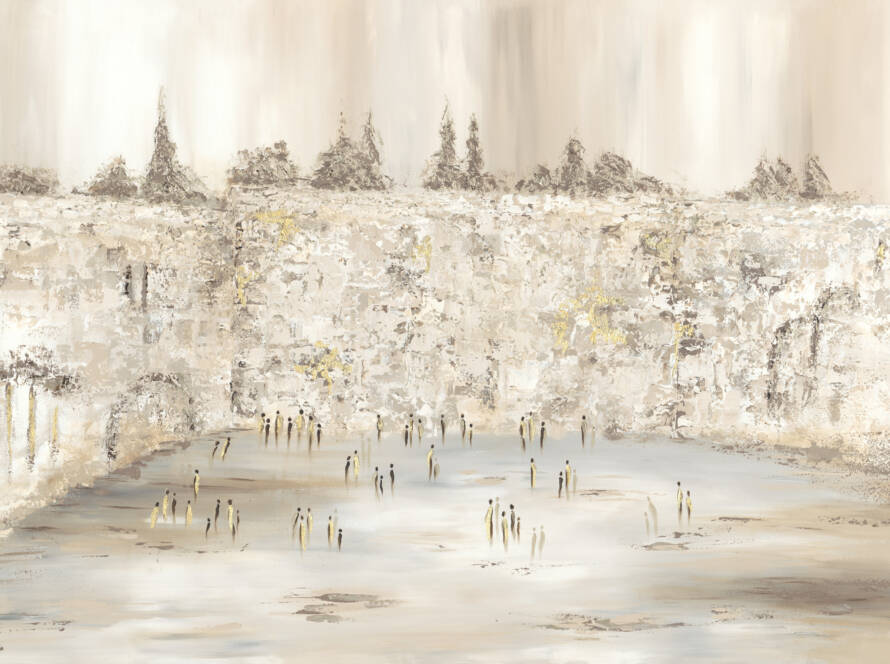
Modern Judaic art is often painted in soft, quiet colours, and quiet colours are the first to suffer under bad lighting. A ceiling bulb that is too cold, too harsh or in the wrong place can flatten a pale palette and turn gold leaf into a glare. This guide explains how to light an original painting at home, with examples from Chaya Koritz’s acrylic and gold leaf works, so the colours you fell in love with are the colours you see on your wall.
Why these paintings need careful light
Raised in the Haredi community of Mea Shearim in Jerusalem, Chaya ran her own sheitel salon for ten years before closing that flourishing business to pursue painting. She taught herself in a home studio, experimenting with paints, applications and gold leaf, and later joined Studio Kli as a resident artist, where she continues to develop her expressionistic style under the guidance of Kira Wolf. You can read the full story on her About page.
The result is a body of work built on light colours, calming palettes and touches of gold. Those are exactly the qualities that lighting can make or break. Strong contrast survives a poor bulb; muted golds, pale blues and soft lavenders do not.
Start with daylight, but keep the sun off the canvas
Indirect daylight shows colour honestly, so a wall that gets bright, soft light during the day is a good start. Direct sun is a different matter. Her FAQ advises keeping paintings and prints out of direct sunlight and away from high humidity. Before you hang, watch the wall for a day: if a patch of sun crosses it in the afternoon, choose another wall or use sheer curtains or blinds at that hour.
Choose the right bulb
- Look for a high colour rendering index (CRI). Bulbs rated CRI 90 or above show colours more faithfully than standard bulbs, which matters most with subtle palettes.
- Pick a warm to neutral colour temperature. Around 2700 to 3000 K feels warm and homely; around 3000 to 3500 K is more neutral. Very cool, bluish light tends to make warm tones look grey.
- Prefer LED. LED bulbs run cool and give off very little ultraviolet light, so they are a safer choice near a canvas than halogen.
- Add a dimmer if you can. The same painting can look right at full brightness in the afternoon and too bright in the evening.
Get the angle right
Whether you use a ceiling spotlight, a track light or a picture light above the frame, aim the beam at the painting from roughly 30 degrees off the wall. Too steep and the top of the canvas burns while the bottom falls into shadow; too shallow and the light bounces straight back into your eyes. Then stand where you normally sit or walk past and look for hot spots and reflections before you fix anything in place.
Lighting gold leaf paintings
Gold leaf reflects light rather than simply absorbing it, so it changes as you move. The artwork page for Circle of Faith (80×80 cm, acrylic and gold leaf on canvas), three Hasidic men dancing in a radiant circle of gold, puts it simply: the gold leaf catches the light in a way that shifts with your perspective.

Golden Jerusalem (80×140 cm, acrylic and gold leaf on canvas) lets gold leaf shimmer across the walls and rooftops of the city, set against muted earth tones and soft creams. To get the most from a piece like this:
- Use a soft, wide beam rather than a narrow spot, so the gold glows across the surface instead of flashing in one place.
- Keep the light slightly to one side, so the reflection falls away from where you usually sit.
- A warm white of around 2700 to 3000 K brings out the gold; a very cool light can make it look brassy.
- Do not over-light it. Gold leaf already returns light to the room, so a dimmer setting often looks richer.
Lighting blue and pastel palettes
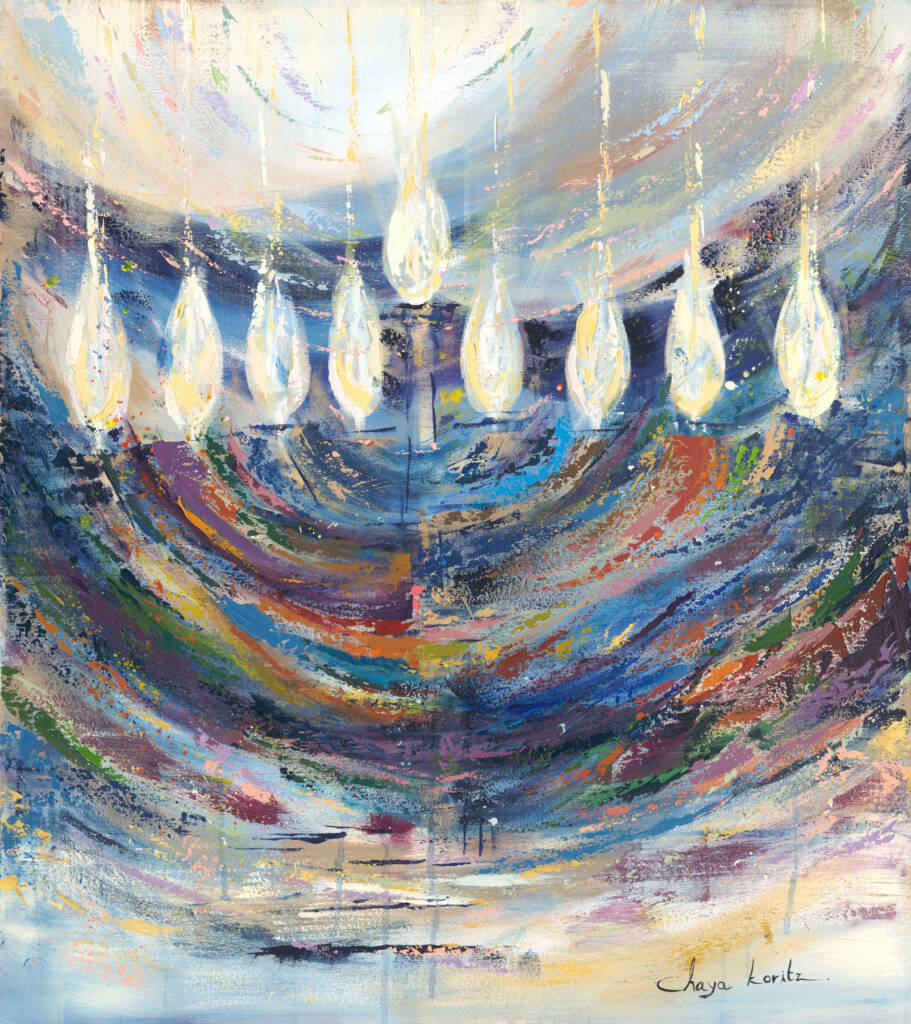
Sacred Blue: A Moment at the Kotel (80×90 cm, acrylic on canvas) immerses the whole scene, the figures in prayer, the ancient stones and the sky, in shades of blue. Jerusalem Beneath the Light of the Menorah (70×90 cm, acrylic on canvas) places a great menorah above the Jerusalem skyline in muted golds, pale blues and soft lavenders.
Blues and lavenders need enough light to stay clear. A very warm, dim bulb can make them look murky, so a neutral white of around 3000 to 3500 K with a high CRI is usually the better choice here. If the room is lit mostly by warm lamps in the evening, a dedicated light on the painting keeps its colours true.
Lighting warm neutrals
Living Light: Contemporary Judaica Art (90×80 cm, acrylic on canvas) is a menorah whose candles seem to glow, painted in soft neutrals and warm earth tones. Warm palettes like this are the most forgiving: a warm white of around 2700 to 3000 K suits them, and gentle side light shows the movement of the brushstrokes.
Placement and size
Lighting works best once the painting is the right size for the wall and hung at a comfortable height. Her canvases range from 70×90 cm to 100×150 cm; our guide to what size painting to choose for your wall covers sizing and hanging height. Note that, according to the FAQ, paintings sent abroad are shipped rolled and the studio recommends framing in your home country, so plan the frame before you plan the light.
Her collections at a glance
Each of her collections has its own palette, which is a useful starting point when you plan the lighting.
| Collection | Example painting | Size and medium |
|---|---|---|
| Hasidic Art and Chasidic Paintings | Circle of Faith – Expressive Hasidic Dance in Jewish Art | 80×80 cm (32×32 in), acrylic and gold leaf on canvas |
| Original Jerusalem Paintings | Golden Jerusalem – Strength, Spirit, and Sacred Beauty | 80×140 cm (32×55 in), acrylic and gold leaf on canvas |
| Beit HaMikdash Paintings | Where Time Stands Still: A Vision of the Beit HaMikdash | 80×120 cm (32×47 in), acrylic on canvas |
| Kever Rachel Painting: Rachel’s Tomb | Kever Rachel: Where Prayers Rise | 100×150 cm (39×59 in), acrylic on canvas |
| Kotel and Western Wall Paintings | Sacred Blue: A Moment at the Kotel | 80×90 cm (32×35 in), acrylic on canvas |
| Parting of the Red Sea Painting | Freedom Awaits the Jewish People | 80×130 cm (32×51 in), acrylic and gold leaf on canvas |
Painting for a particular room
If you already know the wall, the light and the colours of a room, a commissioned painting can be planned around them. Chaya creates commissions for homes and for sacred spaces such as synagogues; the process starts with a description of the space, the subject and the colours you have in mind.
To ask about a specific painting or a commission, get in touch and tell the studio about the room where it will hang.
Frequently asked questions
What colour temperature is best for lighting a painting at home?
For most paintings, a warm to neutral white between about 2700 and 3500 K with a CRI of 90 or above works well. Warmer light flatters golds and earth tones; slightly more neutral light keeps blues and lavenders clear.
Can a painting hang in direct sunlight?
It is best avoided. The studio’s FAQ advises keeping paintings and prints out of direct sunlight and high humidity, and dusting gently with a soft, dry cloth if needed.
How do I stop glare on a gold leaf painting?
Light it from about 30 degrees off the wall, keep the beam soft and slightly to one side, and check the reflection from where you usually sit. A dimmer helps, because gold leaf already reflects light back into the room.
Can I commission a painting for a specific space?
Yes. Chaya creates commissioned paintings for homes and sacred spaces. Start by describing the space, the subject and the colours you have in mind.