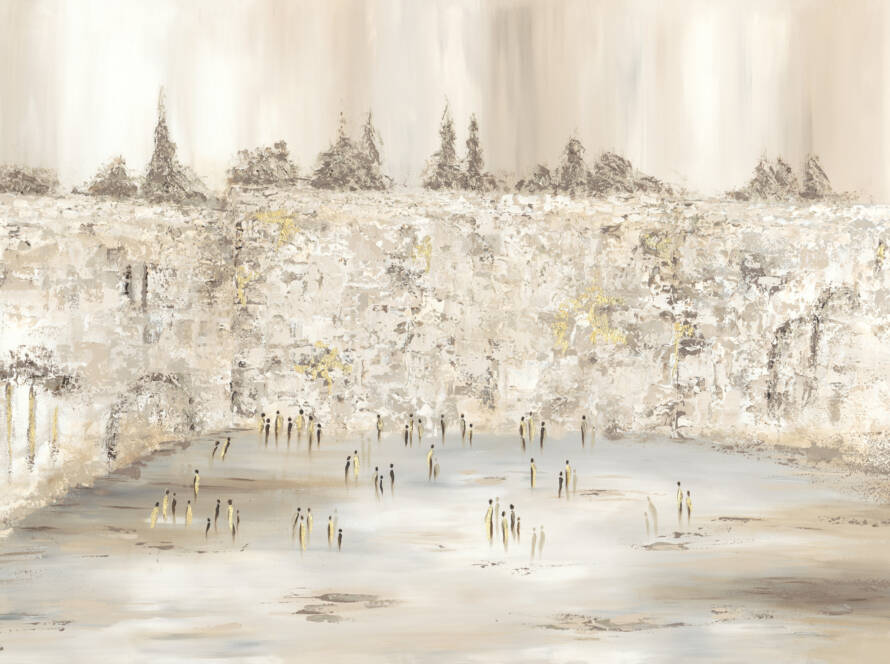
Throughout Jewish history, certain places have carried a weight that transcends geography. The Beit HaMikdash, the Western Wall, the circle of a Hasidic dance—these are not simply locations but thresholds where the human spirit meets the divine. For Chaya Koritz, painting these sacred spaces is an act of spiritual archaeology: unearthing the emotions that have accumulated in these places over thousands of years and giving them new visual form.
In this post, we explore three paintings from Chaya’s collection that each capture a different dimension of sacred space—the grandeur of the Temple, the ecstasy of communal dance, and the quiet intimacy of prayer at the Kotel.
The Beit HaMikdash: Where Time Stands Still
The Holy Temple has not stood in Jerusalem for nearly two thousand years, yet it remains the spiritual center of Jewish consciousness. In Where Time Stands Still: A Vision of the Beit HaMikdash, Chaya Koritz accomplishes something remarkable: she paints a building that no living person has seen, yet makes it feel utterly real and present.
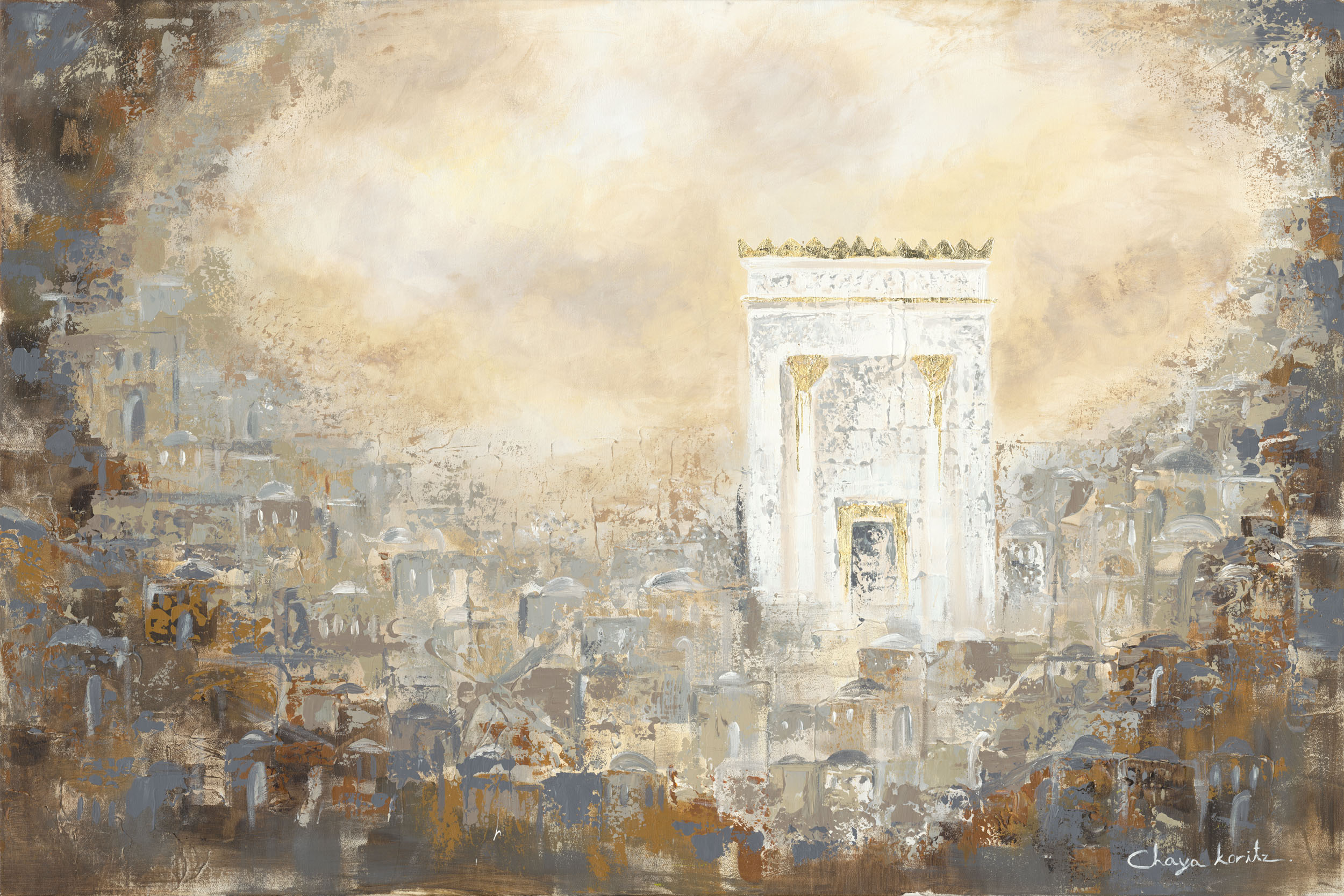
The painting blends majestic architecture with an ethereal, almost dreamlike atmosphere. Soft washes of color dissolve the hard edges of stone, suggesting that the Temple exists not merely as a historical structure but as a living vision carried in collective memory. The composition draws the eye upward, mirroring the way the Temple was designed to lift the soul toward heaven. Gold accents shimmer throughout, recalling the vessels and adornments described in the Torah, while cooler tones in the background evoke the vast sky above Jerusalem.
What makes this piece so powerful is its refusal to be purely historical. Chaya paints the Beit HaMikdash as something that exists in the present tense of Jewish longing—a place that lives in prayer, in study, and in the collective hope for rebuilding.
Circle of Faith: The Sacred Space of Dance
Not all sacred spaces have walls. In Hasidic tradition, a circle of men dancing together in joyful worship creates its own holy ground. Circle of Faith – Expressive Hasidic Dance in Jewish Art captures this transformative moment with extraordinary energy and warmth.
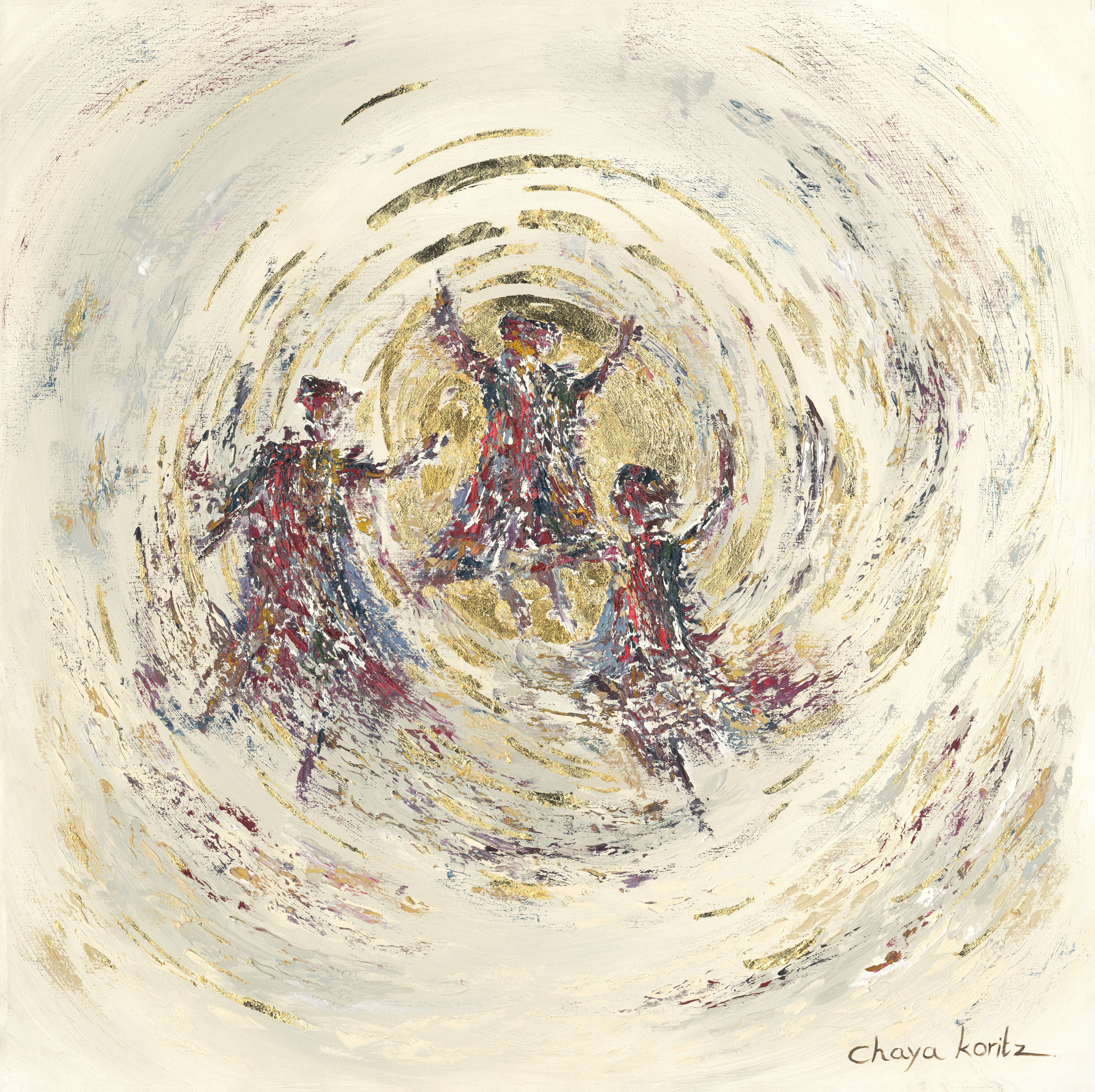
Three Hasidic men dance within a golden circle, their figures rendered with bold, expressive brushstrokes that convey motion and abandon. The gold ring encircling them is both a visual motif and a spiritual symbol—it represents the boundary between ordinary space and the sacred zone created by simcha (joy). The dancers’ dark clothing contrasts with the luminous background, grounding their physical presence while their movement seems to lift them beyond the material world.
Chaya’s treatment of this subject goes beyond illustration. She captures the precise moment when individual bodies dissolve into collective spirit, when the boundary between self and community becomes as fluid as her brushstrokes. It is a painting about the sacred geometry of togetherness.
Sacred Blue: Stillness at the Western Wall
If the Beit HaMikdash represents the grandeur of divine architecture and the Hasidic dance embodies the ecstasy of communal worship, then Sacred Blue: A Moment at the Kotel captures something quieter and equally profound—the intimate stillness of personal prayer.
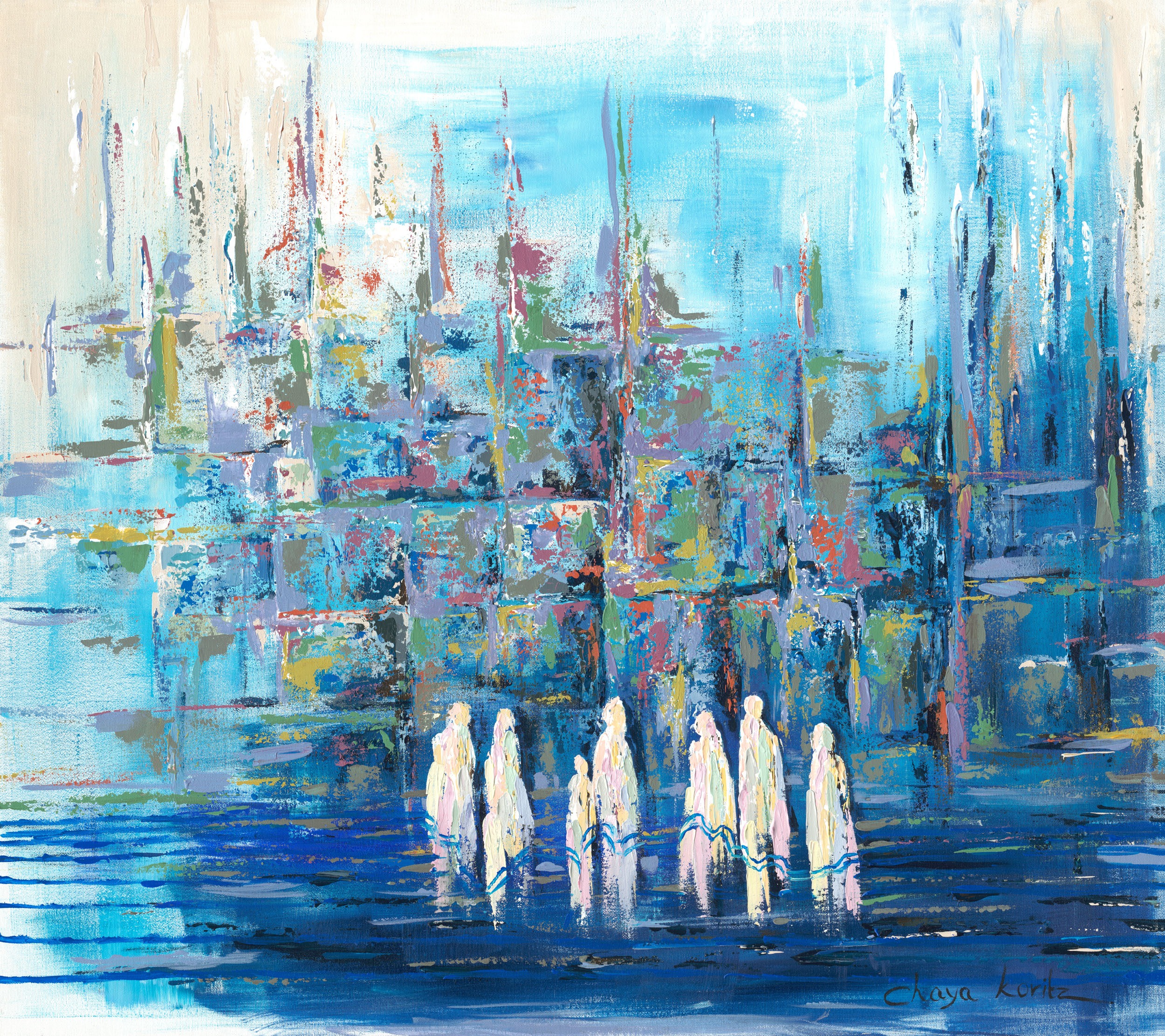
Rendered almost entirely in calming shades of blue, this painting envelops its subjects in an atmosphere of deep serenity. The worshippers at the Wall are not individualized portraits but archetypal figures—they represent every person who has ever stood before these ancient stones and poured out their heart. The blue palette, traditionally associated with techelet (the sacred blue of the tzitzit), reinforces the painting’s spiritual register, connecting the act of prayer to the commandments and covenants that define Jewish life.
The composition is deliberately still. Where the Hasidic dance painting pulses with movement, this work invites the viewer to slow down, to breathe, to stand at the Wall alongside these quiet figures and feel the weight of two thousand years of prayers soaked into the stone.
Three Dimensions of the Sacred
Together, these three paintings form a meditation on what makes a space sacred in Jewish art and tradition. The Temple is sacred through divine design. The dance circle is sacred through communal joy. The Wall is sacred through accumulated prayer. Chaya Koritz understands that holiness is not a single note but a chord—and her collection gives voice to each of its harmonics.
Whether you are drawn to the grandeur of ancient architecture, the vitality of Hasidic celebration, or the quiet power of personal devotion, these works invite you to create your own sacred space at home. Explore the full Chaya Koritz collection to find the painting that resonates with your spirit.